A Practical, Honest, and Data-Backed Guide for Long-Term Growth
Search engine optimization can feel like a battlefield. Some marketers build sustainable growth. Others chase shortcuts.
If you’re searching for the difference between white hat and black hat SEO, you’re asking the right question.
Because in SEO, how you win matters just as much as winning.
This guide explains:
- What is white hat SEO
- What is black hat SEO
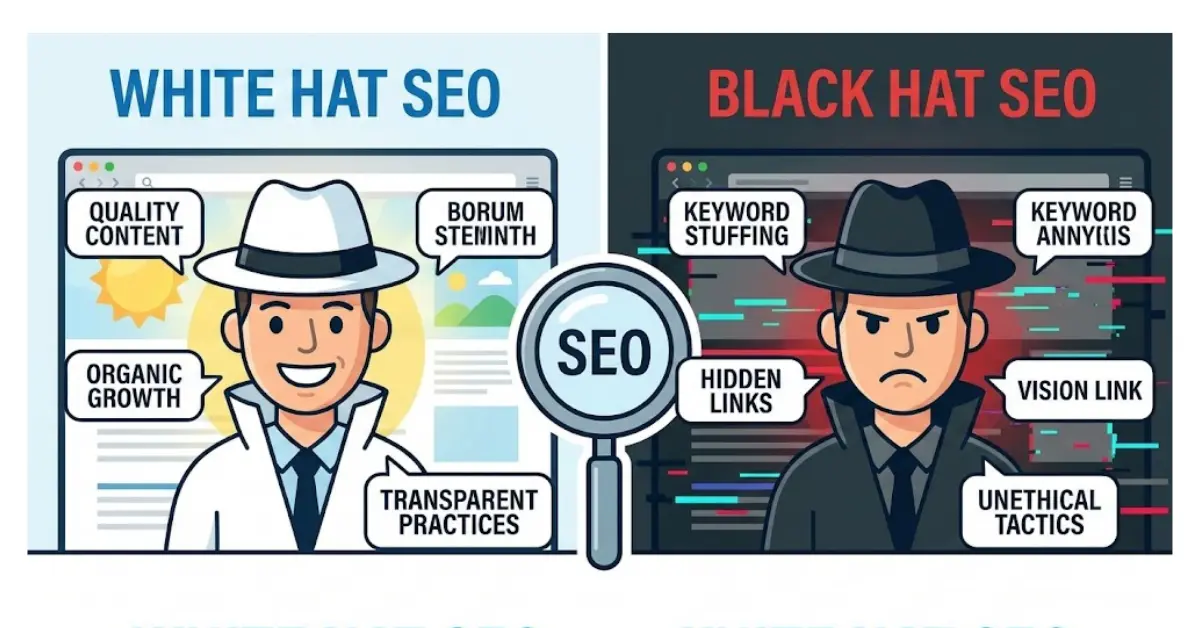
- White hat SEO vs black hat SEO
- White hat vs black hat SEO techniques
- White hat SEO examples
- Black hat SEO examples
- Black hat SEO penalties
- Is black hat SEO illegal?
- How Google algorithm updates detect manipulation
- SEO best practices aligned with search engine guidelines
Everything here follows verified information from Google Search Essentials (formerly Webmaster Guidelines) and official documentation from Google Search Central. No myths. No exaggerated claims. Just facts.
What Is White Hat SEO?
White hat SEO refers to optimization techniques that follow Google’s official Search Essentials guidelines.
Google clearly states that site owners should focus on creating helpful, reliable, and people-first content. That guidance appears in Google’s documentation on creating helpful content and maintaining site quality standards.
White hat SEO focuses on:
- Creating valuable content for users
- Improving website usability
- Earning links naturally
- Optimizing technical performance
- Following search engine guidelines
In simple terms:
You help users first. Rankings follow.
Why White Hat SEO Works
Google’s ranking systems aim to reward helpful content. The Helpful Content System and Core Updates focus on experience, expertise, authoritativeness, and trust.
In Google’s official guidance on creating helpful, people-first content, published on Google Search Central, the company emphasizes that content should demonstrate experience, expertise, authoritativeness, and trust. Google advises site owners to focus on satisfying user intent rather than trying to manipulate ranking signals.
Google does not reward manipulation long term. It rewards usefulness.
White hat SEO builds:
- Sustainable organic traffic
- Brand credibility
- Long-term keyword rankings
- Low penalty risk
It’s slower than shortcuts. But it compounds over time.
White Hat SEO Examples
Let’s break down practical white hat SEO examples that align with official guidelines.
1. High-Quality Content Creation
Google emphasizes helpful, original content. That means:
- Answering real user questions
- Providing accurate information
- Using trusted sources
- Structuring content clearly
You don’t write for algorithms. You write for humans.
2. Ethical Link Building
White hat link building focuses on earning links through:
- High-value content
- Research studies
- Guest posting with value
- Digital PR
Google warns against buying links or participating in link schemes. Earning links through quality remains the safest approach.
3. Proper On-Page Optimization
This includes:
- Clear title tags
- Meta descriptions
- Logical header structure
- Internal linking
- Mobile optimization
These techniques improve usability, not manipulation.
4. Technical SEO Compliance
Google recommends:
- Fast loading pages
- Secure HTTPS
- Mobile-friendly design
- Crawlable site structure
Technical SEO supports discoverability and user experience.
What Is Black Hat SEO?
Black hat SEO involves tactics that violate Google’s search engine guidelines to manipulate rankings.
These methods aim for quick wins. They often ignore user value.
Google defines spam policies clearly. Violations can result in ranking loss or removal from search results.
According to Google’s Search Essentials: Spam Policies documentation, practices such as cloaking, keyword stuffing, link schemes, automatically generated content, and hidden text violate Google’s quality guidelines. Google explicitly states that sites engaging in these behaviors may receive manual actions or be affected by algorithmic spam detection systems.
Black hat SEO focuses on:
- Manipulating search algorithms
- Exploiting ranking loopholes
- Prioritizing bots over users
It might work temporarily. It rarely works long term.
Black Hat SEO Examples
Understanding black hat SEO examples helps you avoid costly mistakes.
1. Keyword Stuffing
Keyword stuffing means overloading a page with repeated keywords to manipulate rankings.
Google explicitly lists this practice as spam in its spam policies documentation.
Example:
“Best SEO agency best SEO company cheap SEO services SEO experts near me.”
Users hate it. Google detects it.
2. Cloaking
Cloaking shows one version of content to search engines and another to users.
Google considers this a serious violation.
If you show bots optimized content and users something else, you risk removal from search.
3. Buying Links
Google’s guidelines clearly state that buying or selling links to manipulate rankings violates policies.
Google’s official Link Spam Policies documentation specifies that exchanging money for links, excessive link exchanges, or using automated programs to build backlinks are considered link schemes. These practices can result in algorithmic demotion or manual penalties.
Paid links without proper rel=”sponsored” or rel=”nofollow” attributes can trigger penalties.
4. Hidden Text and Links
Some websites hide keywords in white text on white backgrounds.
Search engines detect this easily today.
5. Automated Content
Publishing large volumes of low-value AI or scraped content without human review violates Google’s spam policies.
Automation itself is not banned. Spam automation is.
Intent matters.
White Hat SEO vs Black Hat SEO: Core Differences
Here’s a clean comparison.
1. Intent
White hat SEO helps users.
Black hat SEO manipulates algorithms.
2. Risk Level
White hat SEO carries minimal risk.
Black hat SEO can trigger manual or algorithmic penalties.
3. Sustainability
White hat builds long-term equity.
Black hat creates short-term spikes.
4. Alignment with Google
White hat aligns with Google’s systems.
Black hat fights them.
Fighting Google rarely ends well.
White Hat vs Black Hat SEO Techniques Compared
| Factor | White Hat SEO | Black Hat SEO |
| Focus | User value | Algorithm manipulation |
| Link Strategy | Earned links | Purchased or spam links |
| Content | Original and helpful | Duplicated or stuffed |
| Risk | Low | High |
| Long-Term Results | Stable | Unpredictable |
| Compliance | Follows search engine guidelines | Violates guidelines |
Simple rule:
If you wouldn’t explain the tactic proudly to Google, don’t use it.
Black Hat SEO Penalties: What Actually Happens?
Google uses two primary systems to address spam:
- Algorithmic Actions
- Manual Actions
Algorithmic Penalties
Google’s systems, including SpamBrain, detect spam patterns automatically.
Traffic drops can happen without warning.
Manual Actions
A human reviewer applies manual penalties when they detect violations.
Google notifies site owners in Search Console.
Penalties may include:
- Ranking demotion
- Partial deindexing
- Complete removal from search results
According to Google Search Central’s Manual Actions Report documentation, a manual action occurs when a human reviewer determines that pages on a site violate Google’s spam policies. When this happens, Google may lower rankings or remove pages entirely from search results until the issue is fixed and a reconsideration request is approved.
Recovery requires fixing issues and submitting reconsideration requests.
That process can take weeks or months.
Is Black Hat SEO Illegal?
This question appears often.
Black hat SEO is usually not illegal under criminal law.
However:
- It violates Google’s terms and policies
- It may breach contracts
- It can cause financial damage
In some cases, hacking websites, injecting malware, or scraping copyrighted content can cross legal boundaries.
So while keyword stuffing won’t send you to jail, hacking certainly can.
More importantly, black hat tactics destroy brand trust.
How Google Algorithm Updates Changed SEO
Google algorithm updates continuously refine ranking systems.
Major updates like:
- Panda (content quality)
- Penguin (link spam)
- Helpful Content Updates
- Core Updates
focus on improving search quality.
According to Google Search Central’s Core Updates documentation, these updates are designed to improve how Google assesses overall content quality.
Google explains that sites experiencing ranking drops after a core update should focus on improving content depth, originality, and user value rather than looking for technical loopholes.
Similarly, Google’s Spam Policies documentation clarifies that systems such as SpamBrain are built to detect manipulative practices at scale.
Google confirms that updates target spam and low-value content.
Each update reduces the effectiveness of manipulative tactics.
In short:
Black hat gets harder every year.
White hat gets stronger every year.
SEO Best Practices That Align With Search Engine Guidelines
Google provides clear documentation on SEO best practices.
Here are principles that consistently work.
1. Create People-First Content
Google’s helpful content guidance encourages writing for humans first.
Ask:
- Does this page solve a problem?
- Does it provide unique insight?
- Would users bookmark it?
If yes, you’re on track.
2. Demonstrate Experience and Expertise
Google highlights the importance of experience and trust signals.
You can strengthen this by:
- Adding author bios
- Citing credible sources
- Providing transparent contact information
- Updating outdated content
Trust drives rankings.
3. Improve Technical Performance
Google’s Page Experience documentation emphasizes:
- Mobile usability
- Secure browsing
- Core Web Vitals
Users prefer fast, secure sites.
Google rewards them.
4. Build Natural Backlinks
Earn links by:
- Publishing research
- Sharing case studies
- Creating tools
- Offering expert commentary
Authority builds organically.
Why White Hat SEO Wins Long Term
White hat SEO compounds.
When you publish helpful content:
- It earns backlinks
- It builds brand searches
- It improves topical authority
- It increases dwell time
Over time, this strengthens domain credibility.
Black hat tactics rarely scale sustainably.
Think of it like fitness.
White hat SEO = consistent workouts and healthy food.
Black hat SEO = crash diet before a photoshoot.
One builds strength. The other builds regret.
When Temptation Strikes
Many businesses feel pressure.
Competitors rank higher. Deadlines loom. Revenue dips.
Shortcuts look attractive.
But remember:
Google’s mission focuses on organizing information and delivering helpful results.
Trying to outsmart a system designed by thousands of engineers rarely works long term.
Instead, invest in:
- Strong content strategy
- Clear keyword research
- Structured internal linking
- Data-driven optimization
You don’t need tricks. You need consistency.
How to Audit Your Site for Risky Practices
If you’re unsure whether your SEO crosses into risky territory, review:
- Link profile quality
- Anchor text diversity
- Content originality
- Keyword density
- Redirect practices
Use Google Search Console to monitor manual actions.
Transparency protects you.
Final Verdict: White Hat SEO vs Black Hat SEO
The difference between white hat and black hat SEO comes down to one core principle: sustainability versus shortcuts.
White hat SEO follows search engine guidelines and builds long-term authority.
Black hat SEO attempts to manipulate rankings and carries serious risk.
If your goal is stable organic growth, brand credibility, and consistent traffic, white hat SEO remains the smarter strategy.
Short-term tricks may create temporary spikes. Sustainable value creates lasting results.