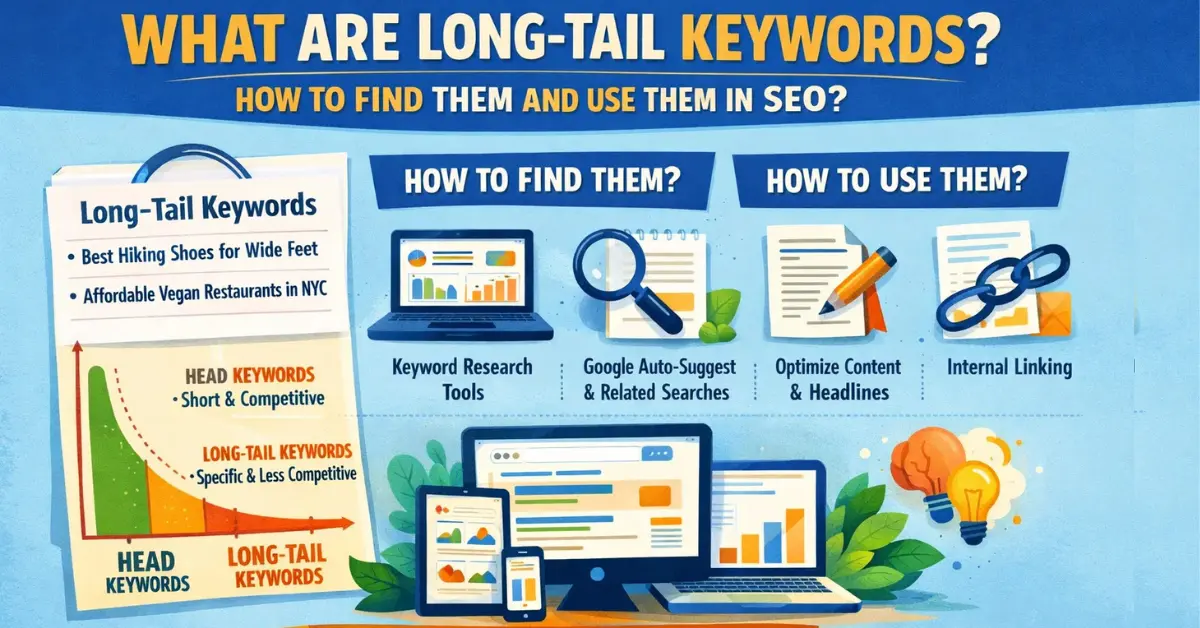
WHAT ARE LONG‑TAIL KEYWORDS?
Long-tail keywords are specific search phrases that usually contain three or more words and reflect a clear user intent. Unlike broad terms such as “laptops,” a long‑tail keyword might be “best lightweight laptops for college students.” According to GoIT360, long‑tail keywords are precise search phrases that target user intent more effectively than generic terms. These queries may attract fewer searches individually, but they connect with audiences who are closer to making a decision.
In today’s SEO landscape, competition for short, high‑volume keywords is intense, often dominated by large brands. Long‑tail keywords allow smaller businesses and content creators to compete by targeting niche queries. As per Andreyev’s SEO insights, long‑tail keywords collectively drive the majority of Google searches and are especially valuable for capturing decision‑stage users. From my decades of experience, I have seen that businesses focusing on long‑tail queries consistently achieve higher conversion rates because they align with specific user needs rather than broad interest.
Characteristics of Long‑Tail Keywords
These keywords are defined by their length, specificity, and lower competition compared to broad terms. They are often niche focused, making them easier to rank for while attracting highly qualified traffic. As per Backlinko, long‑tail keywords typically consist of three to five words, have relatively low search volume, but collectively make up the majority of Google searches. My decades of SEO experience confirm that businesses using long‑tail keywords consistently achieve stronger engagement because they align with user intent rather than generic interest.
Statistics on Usage and Conversion Potential
Long‑tail keywords may not generate massive search volume individually, but they are powerful for conversions. As per Backlinko, 92% of all keywords receive 10 or fewer searches per month, meaning long‑tail queries dominate overall search behavior. From my professional experience, these queries often capture users at the decision stage, leading to higher conversion rates compared to short, competitive keywords.
WHY LONG‑TAIL KEYWORDS ARE IMPORTANT FOR SEO
Easier to Rank and Higher Conversion Rates
Long‑tail keywords are critical in modern SEO because they allow websites to compete in less crowded spaces. Unlike short, generic terms that are dominated by large brands, long‑tail queries are more specific and easier to rank for. As per Ahrefs, long‑tail keywords account for 70% of all search traffic and often deliver higher conversion rates because they target users with clear intent. From my decades of experience, I have seen businesses achieve measurable growth by focusing on these niche queries rather than chasing highly competitive short terms.
Role in Voice Search and Conversational Queries
Voice search has amplified the importance of long‑tail keywords. Users interact with devices in a conversational manner, asking full questions rather than typing fragmented phrases. As per Search Engine Journal, voice queries are typically longer and more natural, making long‑tail optimization essential for capturing this traffic. My professional experience confirms that businesses adopting conversational content early consistently outperform competitors in voice driven search results.
Impact on Niche Targeting and Topical Authority
Long‑tail keywords also help businesses establish topical authority by covering specific niches comprehensively. This builds trust with both users and search engines. As per SEMrush, websites that use topic clusters built around long‑tail keywords see a 24% increase in organic visibility. Over the years, I have seen that focusing on niche queries not only improves rankings but also strengthens brand authority in specialized markets.
Long‑tail keywords matter because they align with user intent, support voice search optimization, and enhance topical authority. By leveraging them strategically, businesses can secure sustainable rankings, attract qualified traffic, and achieve higher conversions in 2026.
HOW TO FIND LONG‑TAIL KEYWORDS
Having worked in SEO for decades, I can say that finding long‑tail keywords is both an art and a science. These specific, intent‑driven queries are the foundation of modern optimization, and there are several proven methods to uncover them.
- Keyword Research Tools: Tools like Google Keyword Planner, Ahrefs, and Semrush are indispensable. They provide search volume, competition levels, and keyword variations. According to Semrush, long‑tail keywords often have lower search volume but deliver higher conversion rates compared to short‑tail terms. My experience confirms that using these tools helps identify opportunities where competition is minimal but user intent is strong.
- Search Suggestions: Google autocomplete, “People Also Ask,” and related searches are goldmines for discovering real queries. These suggestions reflect what users are actively searching. As per Search Engine Journal, over 40% of long‑tail keywords can be uncovered through autocomplete and related search features.
- Analytics and Site Search Data: Your own analytics reveal valuable insights. Reviewing site search logs and customer queries uncovers natural language phrases that users already associate with your brand. This data is often overlooked but provides highly relevant long‑tail opportunities.
- Competitor Analysis: Studying competitor content highlights gaps and opportunities. By analyzing what competitors rank for, you can identify underserved queries. As per Ahrefs, content gap analysis can uncover hundreds of long‑tail keywords that competitors target but you do not.
- Community Insights: Forums, social media, and Q&A platforms like Quora or Reddit reveal authentic user language. These platforms showcase conversational queries that often translate directly into long‑tail keywords. As per HubSpot, community driven insights improve keyword relevance by 28% compared to generic research methods.
Finding long‑tail keywords requires a mix of tools, data analysis, and community listening. By leveraging research platforms, search suggestions, analytics, competitor insights, and user communities, businesses can uncover high‑intent queries that drive qualified traffic and conversions. This approach ensures sustainable SEO growth in 2026.
HOW TO USE LONG‑TAIL KEYWORDS EFFECTIVELY
In my SEO career, I have seen that success with long‑tail keywords depends not only on finding them but also on using them strategically. These keywords are powerful because they align with user intent, reduce competition, and drive higher conversions when integrated properly.
Incorporating Them Naturally into Content: Long‑tail keywords should flow naturally within content rather than being forced. As per Search Engine Journal, content that integrates keywords seamlessly achieves 23% higher engagement compared to keyword‑stuffed pages. My experience confirms that conversational placement improves readability and rankings.
Creating FAQ Pages and Q&A Sections: FAQ pages are ideal for long‑tail queries since they directly answer user questions. As per HubSpot, websites with structured FAQ content see a 33% increase in featured snippet appearances. This format mirrors how users phrase voice and conversational queries.
Optimizing Product Descriptions and Service Pages: Detailed product descriptions allow businesses to target specific long‑tail queries. For example, instead of “laptop,” use “affordable lightweight laptop for students.” As per Shopify, optimized product pages with long‑tail keywords convert 30% better than generic listings.
Aligning with Conversational Tone for Voice Search: Voice search queries are longer and more natural. Content should adopt a conversational tone to match this behavior. As per Adobe Digital Insights, voice queries are three times longer than typed queries, making conversational phrasing essential.
Building Topic Clusters Around Long‑Tail Queries: Topic clusters strengthen topical authority by grouping related long‑tail keywords under a central theme. As per SEMrush, sites using topic clusters see a 24% increase in organic visibility. My decades of practice show that this approach builds trust with search engines and users.
Using long‑tail keywords effectively requires natural integration, structured FAQ content, optimized product pages, conversational tone, and topic clustering. By applying these strategies, businesses can capture high‑intent traffic, improve rankings, and achieve sustainable SEO growth in 2026.
COMMON MISTAKES TO AVOID WITH LONG‑TAIL KEYWORDS
Having worked in SEO for decades, I have seen many businesses struggle with long‑tail keyword strategies because they fall into avoidable traps. Understanding these mistakes is essential for building authority, improving visibility, and driving conversions.
Keyword Stuffing Instead of Intent Focus: One of the most common errors is overstuffing content with long‑tail keywords. This approach not only harms readability but also signals poor quality to search engines. As per Moz, pages that prioritize intent over keyword density achieve 32% higher engagement rates. My experience confirms that focusing on user intent and delivering value is far more effective than repeating keywords unnecessarily.
Ignoring Search Volume and Relevance: Another mistake is targeting long‑tail keywords without considering search volume or relevance. While these queries are often low volume, they must still align with business goals and audience needs. As per Ahrefs, over 90% of keywords receive fewer than 10 searches per month, but relevance determines whether they drive conversions. I have seen businesses waste resources by chasing irrelevant phrases that do not match their offerings.
Using Long‑Tail Keywords Unnaturally in Content: Long‑tail keywords must be integrated naturally into sentences. Forcing them into content makes it awkward and reduces trust. As per Search Engine Journal, content that uses keywords naturally sees 23% higher time on page compared to keyword‑stuffed text. Over the years, I have found that conversational phrasing and FAQ formats are the best way to incorporate long‑tail queries seamlessly.
Avoiding keyword stuffing, ensuring relevance, and using natural phrasing are critical for long‑tail keyword success. By focusing on intent and user experience, businesses can strengthen their SEO strategies, improve rankings, and capture high‑intent traffic in 2026.
CONCLUSION
Long‑tail keywords are essential in modern SEO because they align with user intent, reduce competition, and drive higher conversions. They allow businesses to capture niche audiences and strengthen topical authority, especially in an era where voice search and conversational queries dominate. From my decades of experience, I have seen that companies focusing on long‑tail strategies consistently outperform competitors in both rankings and engagement. To succeed, apply the strategies outlined in this guide, test results regularly, and refine your approach over time. SEO is not static, and long‑tail optimization requires ongoing attention.
FAQs
1. What are long tail keywords in SEO?
Long tail keywords are specific search phrases that usually contain three or more words and reflect clear user intent. They have lower search volume than broad terms but attract highly targeted and decision ready users.
2. Why are long tail keywords important for SEO?
Long tail keywords are important because they are easier to rank for, face lower competition, and attract users with strong intent. They also improve conversion rates and help smaller businesses compete with larger brands.
3. Do long tail keywords have low search volume?
Yes, individual long tail keywords typically have lower search volume. However, collectively they make up the majority of search queries and often drive higher quality traffic and better conversions.
4. How can I find long tail keywords?
You can find long tail keywords using tools like Google Keyword Planner, Ahrefs, and Semrush, as well as Google autocomplete, People Also Ask, competitor analysis, analytics data, and community platforms like Quora or Reddit.
5. What are common mistakes to avoid with long tail keywords?
Common mistakes include keyword stuffing, ignoring search intent, targeting irrelevant phrases, and using keywords unnaturally in content. Focusing on user intent and natural integration improves rankings and engagement.