Introduction
Imagine you’re running a website, and every day people are walking through your digital “front door.” Some arrive because they searched for something on Google, others because they clicked an ad, a few because another site recommended you, and some simply typed your URL directly. All of these visitors together make up what we call SEO traffic and understanding the different types of traffic in SEO is one of the most important skills in digital marketing.
Now, why does this matter?
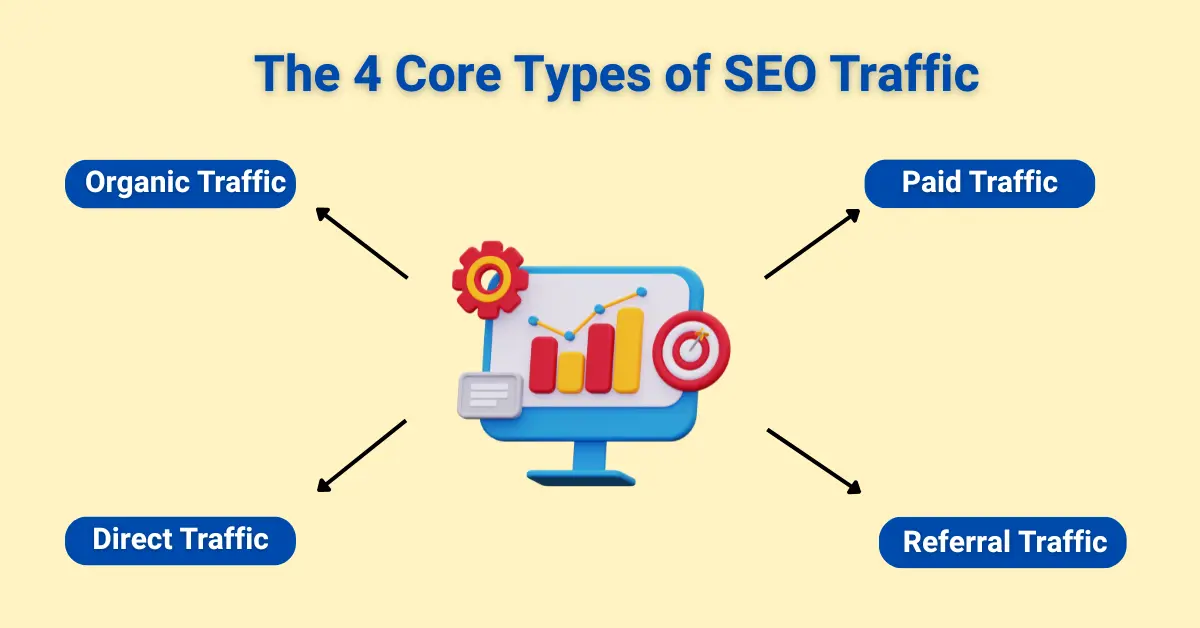
In SEO, we usually break traffic down into four main categories:
- Organic traffic: These are visitors who find you naturally through search engines. It’s the result of strong content, keyword optimization, and technical SEO. Organic traffic is often the most valuable because it reflects genuine interest.
- Paid traffic: This comes from ads whether on Google, Facebook, or other platforms. It’s fast and effective but requires budget and careful targeting.
- Referral traffic: These visitors arrive because another website linked to you. Think of it as digital word-of-mouth that also boosts your authority in search rankings.
- Direct traffic: This is when someone types your web address directly or uses a bookmark. It’s a sign of brand recognition and loyalty.
By the end of this guide, you’ll not only know what each traffic type means but also how to leverage them to build credibility, authority, and trust and the very principles behind Google’s EEAT framework.
WHAT IS SEO TRAFFIC?
Let’s start with the basics. When we talk about SEO traffic, we’re really talking about the visitors who land on your website as a result of search engine activity. In simple terms, it’s the flow of people coming to your site after typing queries into Google, Bing, or other search engines. Think of it as the digital equivalent of foot traffic in a store and without it, even the best products remain unseen.
Now, you might be wondering: what is website traffic in marketing?
In marketing, traffic represents the audience you attract online. It’s not just about how many people visit, but also about who they are, what they’re looking for, and whether they take action once they arrive. That’s why marketers pay close attention to traffic sources and patterns because they reveal how effective your SEO and overall digital strategy really are.
Measuring Traffic with Google Analytics & Search Console
Tools like Google Analytics and Google Search Console are the industry standards. Analytics shows you where visitors come from, how long they stay, and what actions they take. Search Console, on the other hand, focuses on how your site performs in search results which keywords drive clicks, how often your pages appear, and whether there are technical issues holding you back. Together, they give you a clear picture of your SEO health.
Traffic Models and Segmentation
There are different types of traffic models that help us categorize visitors: organic, paid, referral, direct, and even social or email traffic. By segmenting these groups, you can identify patterns and examples of traffic that matter most to your goals. For instance, organic traffic might signal strong content performance, while referral traffic highlights the value of backlinks.
Understanding these foundations sets the stage for exploring the different types of traffic in SEO and how each contributes to building authority, trust, and long‑term growth.
The 4 Core Types of SEO Traffic
Now that understood about SEO traffic, let’s break it down into the four core categories you’ll hear about most often: Organic, Paid, Referral, and Direct traffic. Think of these as the “big four” that every marketer needs to understand.
1. Organic Traffic
Organic Traffic is the crown jewel of SEO. Organic traffic comes from unpaid search engine results, which means people typing queries into Google and clicking on your site because it matches their intent. It’s built through keyword optimization, high-quality content, and technical SEO.
Why is it so valuable?
Because it reflects genuine interest. If someone finds you organically, it means your content answered their question or solved their problem.
2. Paid Traffic
Paid traffic is the opposite side of the coin. It comes from ads such as Google Ads, Facebook campaigns, sponsored posts, you name it. The advantage is speed: you can get visibility almost instantly. But here’s the catch. It costs money, and once you stop paying, the traffic stops. That’s why marketers often compare paid traffic vs organic traffic to balance short-term gains with long-term growth.
3. Referral Traffic
Referral traffic happens when someone clicks a link to your site from another website. Imagine a blog recommending your product or a directory listing your business. Not only does this bring visitors, but it also signals to search engines that your site is trustworthy. Backlinks are a major driver here, and they’re a cornerstone of SEO authority.
4. Direct Traffic
Finally, direct traffic. This is when users type your URL directly into their browser or use a bookmark. It’s a sign of brand recognition and loyalty as people already know you and want to come back.
Other Traffic Classifications
So far, we’ve covered the “big four” traffic types. But in real-world digital marketing, traffic isn’t limited to just those categories. There are other classifications that give us a more complete picture of how people find and interact with your website. Let’s walk through them.
1. Social Traffic:
This is traffic that comes from social media platforms like Facebook, Instagram, LinkedIn, or Twitter (X). When someone clicks a link in a post, ad, or profile, that visit is tracked as social traffic. It’s powerful because it combines brand awareness with community engagement. In fact, many marketers consider social traffic a bridge between SEO and broader digital marketing strategies.
2. Email Traffic:
If you’ve ever clicked a link in a newsletter or promotional email, you’ve contributed to email traffic. This type of traffic is highly targeted because it usually comes from people who already know your brand. It’s a great example of how segmentation works as you’re reaching a specific audience with tailored messaging.
3. Display Traffic:
Display traffic comes from banner ads, retargeting campaigns, or other visual advertising formats. While it’s technically paid, it’s often tracked separately because the intent is different. Display ads are more about visibility and brand recall than immediate conversions.
Now, you might be asking: what are 7 types of digital marketing or 4 types of digital marketing?
These broader categories include SEO, social media, email, paid ads, content marketing, influencer marketing, and affiliate marketing. Traffic classifications overlap with these strategies, which is why understanding them is so important.
By recognizing these additional traffic sources, you can build a more holistic SEO plan. Each type whether social, email, or display adds another layer to your marketing funnel and strengthens your site’s authority, trust, and long-term growth.
How Traffic Types Impact SEO Strategy
Now that you know the different types of traffic in SEO, let’s talk about why they matter strategically. Think of traffic as different streams feeding into the same river — each one adds volume, but the quality and direction of the flow determine how strong that river becomes.
Balancing Paid vs Organic Traffic
Organic traffic is often the backbone of SEO strategy. Because it’s earned through content quality, keyword targeting, and technical optimization, it builds long-term credibility. When Google sees consistent organic visitors engaging with your site, it strengthens your authority and aligns perfectly with EEAT, which is showing expertise and trustworthiness.
Paid traffic, on the other hand, is like turning on a faucet. It gives you immediate visibility, which is great for product launches or seasonal campaigns. But it’s not sustainable without budget. Smart marketers use paid traffic to complement organic growth, not replace it. Balancing the two ensures you’re not overly dependent on ads while still capturing quick wins.
Role of Referral Traffic in Authority
Referral traffic plays a unique role in SEO strategy. Every time another site links to you, it’s essentially vouching for your credibility. These backlinks not only bring visitors but also signal to search engines that your content is authoritative. This is why link-building campaigns are so important as these directly impact rankings and EEAT’s “authoritativeness” factor.
Direct Traffic and Brand Loyalty
Direct traffic is a reflection of brand strength. If people are typing your URL directly, it means they already trust you. This kind of loyalty is gold in digital marketing because it often leads to repeat conversions and word-of-mouth growth.
When you put all these traffic types together, you get a holistic SEO strategy. The key is not just driving traffic, but understanding which sources deliver the most value. By analyzing patterns, segmenting audiences, and aligning with EEAT principles, you can turn traffic into measurable business growth.
Tracking Traffic in Google Analytics
Alright, now that we’ve explored the different types of traffic in SEO, let’s talk about how we actually track it. After all, knowing your traffic sources is only useful if you can measure them. That’s where tools like Google Analytics and Google Search Console come in.
Traffic Channels in GA4
Think of Google Analytics as your website’s dashboard. It shows you not just how many people visit, but also where they came from, what they did, and how long they stayed. For example, you can see whether a spike in visitors came from organic search, a paid campaign, or referral links. This helps you answer the question: what are the different types of traffic in Google Analytics? The platform categorizes traffic into channels like Organic, Paid, Referral, Direct, Social, and Email, which gives you a clear breakdown of performance.
Google Search Console complements this by focusing on search-specific data. It tells you which keywords triggered impressions, how often your pages appeared in search results, and what percentage of users clicked through. Together, these tools give you both the “big picture” and the fine details.
Using Segmentation for Insights
Now, here’s where segmentation comes in. By segmenting traffic, you can isolate patterns and better understand user behavior. For instance, you might compare organic visitors against paid visitors to see which group converts more. This ties back to traffic models as these frameworks that help marketers analyze and predict visitor flows. So, when someone asks what are the different types of traffic models, you can explain that they’re essentially ways of categorizing and forecasting how users arrive and interact with your site.
Examples of Traffic Sources
To make this practical, let’s consider examples of traffic: a blog post ranking on Google drives organic traffic, a Facebook ad generates paid traffic, and a backlink from a partner site brings referral traffic. By tracking these examples in Analytics, you can refine your SEO strategy and ensure every visitor counts toward growth.
Conclusion
So, when we talk about the different types of traffic in SEO, we’re really talking about the lifelines of your digital presence. Organic traffic builds authority and trust over time, paid traffic gives you quick visibility, referral traffic strengthens credibility through backlinks, and direct traffic reflects brand loyalty. Add in social, email, and display traffic, and you’ve got a complete ecosystem that shows how people discover and engage with your site.
The key takeaway? Don’t just chase numbers. Focus on understanding where your traffic comes from and why it matters. By analyzing these sources in Google Analytics and Search Console, you can refine your strategy, improve user experience, and align with Google’s EEAT principles. That’s how you turn traffic into conversions, and conversions into long-term growth.
FAQs
1: What are the four types of SEO?
The four types of SEO are on-page SEO, off-page SEO, technical SEO, and local SEO. Each focuses on different aspects of optimization, from content quality to site performance and local visibility.
2: What are the five types of traffic in SEO?
The five major traffic types are organic, paid, referral, direct, and social traffic. Together, they provide a complete view of how users discover and engage with your website.
3: What are the different types of traffic models?
Traffic models are frameworks that categorize and predict visitor flows. Common models include organic vs paid segmentation, device-based models (desktop vs mobile), and behavioral models (new vs returning visitors).
4: What are examples of traffic?
Examples include a visitor clicking your site from Google (organic), someone arriving via a Facebook ad (paid), a backlink from a partner site (referral), or a user typing your URL directly (direct).
5: What are the top traffic sources in digital marketing?
Top traffic sources include search engines, social media platforms, email campaigns, and backlinks. Each source plays a unique role in building visibility, authority, and conversions.